
1. Geographical & Map Formation
Bosnia and Herzegovina occupies a mountainous, heart-shaped territory in the western Balkan Peninsula, bordered by Croatia, Serbia, and Montenegro, with a tiny coastline on the Adriatic Sea. The country's borders have deep roots in medieval principalities and the Ottoman administrative division (Sanjak of Bosnia). In the 20th century, its borders were preserved as a constituent republic within socialist Yugoslavia. Following its declaration of independence in 1992, the country went through a brutal civil war. The borders were reaffirmed and structured by the US-sponsored Dayton Peace Agreement of 1995, which divided the internal territory into two highly autonomous entities—the Federation of Bosnia and Herzegovina and the Republika Srpska—linked by a weak central government.
2. Heraldry & Flag Symbolism
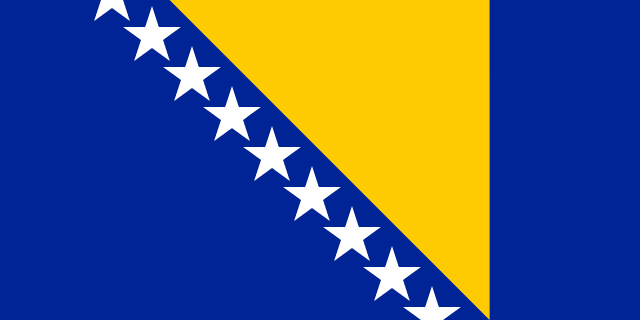
The national flag of Bosnia and Herzegovina features a dark blue field with a yellow right triangle in the center and a diagonal row of white seven-pointed stars along the hypotenuse. The flag was designed by an international commission led by the United Nations and adopted in 1998 to replace the previous coat of arms flag, which was rejected by ethnic factions. The three points of the yellow triangle represent the three main ethnic groups (Bosniaks, Croats, and Serbs) and the general geographical shape of the country; the blue color and white stars represent Europe, symbolizing hope for peace and integration.
3. Path to Freedom & Sovereignty
Bosnia and Herzegovina held a national referendum on independence on February 29 and March 1, 1992, following the secession of Croatia and Slovenia from Yugoslavia. The majority of Bosniaks and Croats voted for sovereignty, leading to a declaration of independence on March 1. However, the Bosnian Serb population boycotted the referendum and, supported by neighboring Serbia, launched a military campaign, initiating a devastating three-year civil war marked by siege, ethnic cleansing, and mass casualties. The war ended in December 1995 with the signing of the Dayton Peace Agreement, establishing the modern sovereign state framework.
Key Historical Milestones
The Ottoman Empire annexes Bosnia, beginning four centuries of Islamic and Turkish cultural influence.
The Austro-Hungarian Empire annexes Bosnia, triggering tensions with Serbia and Russia.
Bosnia and Herzegovina declares independence from Yugoslavia, sparking a devastating civil war.
The Dayton Peace Agreement is signed, ending the war and establishing the modern federal structure.
4. Modern Geopolitical Challenges
Bosnia and Herzegovina's primary challenge is its highly complex and fragmented governance structure. The country is run by a three-member presidency representing the three ethnic groups, which frequently leads to legislative gridlock and blocks structural reforms. Ethnic polarization remains high, with occasional secessionist threats from the Republika Srpska. This political instability has resulted in slow economic growth, high youth unemployment, and a massive demographic decline as young professionals emigrate to the European Union in search of better living standards.
Frequently Asked Questions
What did the Dayton Peace Agreement achieve?
Signed in 1995, it ended the Bosnian War and created the current federal constitutional structure, dividing governance between Bosniaks, Croats, and Serbs.
Why are there stars cut off at the edges of the flag?
The stars are rendered as infinite, cut off at the top and bottom, representing an endless alignment with European ideals of unity.
Think You Can Pin Bosnia and Herzegovina on the Map?
Use the landscape and flag clues you just learned to spot this country in our free Street View guessing game.
Play LostStreet Guessing Game