
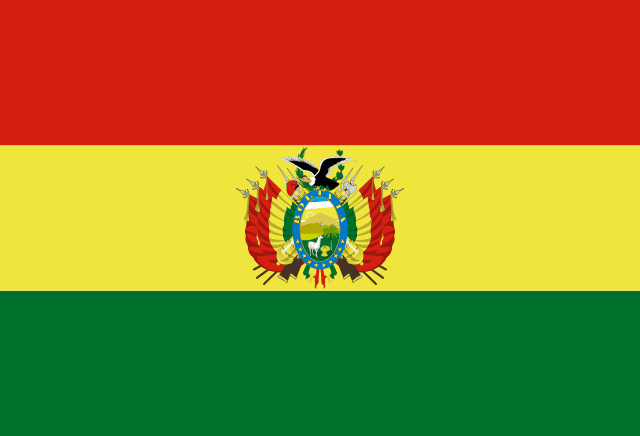
1. Geographical & Map Formation
Bolivia is a landlocked nation dominated by the high peaks of the Andes Mountains in the west and the expansive Amazon basin in the east. Evolving from the colonial Spanish Audiencia of Charcas, Bolivia's boundaries were severely reduced by neighboring nations in post-colonial conflicts. Most notably, the country lost its entire Pacific coastline (the Litoral Department) to Chile during the War of the Pacific (1879-1884), leaving it landlocked. In the 20th century, the Chaco War (1932-1935) with Paraguay led to the loss of a large portion of the southern Gran Chaco region. Today, the country maintains borders with five South American states, including Argentina and Brazil.
2. Heraldry & Flag Symbolism
The national flag of Bolivia consists of three equal horizontal bands of red, yellow, and green, with the national coat of arms in the center of the state flag. The colors hold symbolic meanings: red represents the bravery of Bolivian soldiers and the blood shed for independence; yellow symbolizes the country's rich mineral resources; and green represents the fertility of the land and its agricultural potential. The central coat of arms depicts Mount Potosí (the famous silver mountain), a llama (the national animal), a sheaf of wheat, and a condor, representing the history, wildlife, and natural wealth of the nation, officially adopted in 1851.
3. Path to Freedom & Sovereignty
Bolivia's struggle for freedom was one of the longest in South America, starting with regional rebellions in Sucre and La Paz in 1809 and lasting sixteen years. The liberation campaign was successfully concluded under the leadership of General Antonio José de Sucre and the Liberator Simón Bolívar during the Spanish-American wars of independence. On August 6, 1825, the assembly of provinces declared independence, officially naming the new republic 'Bolivia' in honor of Simón Bolívar, who drafted its first constitution and served as its first president.
Key Historical Milestones
Bolivia declares independence from Spain on August 6, named in honor of Simon Bolivar.
The War of the Pacific with Chile leaves Bolivia landlocked after losing its coastal territory.
The Chaco War with Paraguay results in heavy casualties and territorial loss in the south.
Evo Morales is elected as the first indigenous president, initiating major social and constitutional reforms.
4. Modern Geopolitical Challenges
Bolivia struggles with socio-economic disparities and landlocked economic disadvantages. The country has the highest indigenous population percentage in South America, and addressing historical inequalities between indigenous communities and the urban elite remains a major task. Economically, Bolivia is heavily dependent on natural gas, lithium, and mineral exports, making it vulnerable to commodity price drops. The lack of direct ocean access increases shipping costs, hindering international trade competitiveness, while political polarization frequently triggers strikes and blockades.
Frequently Asked Questions
Why does Bolivia have two capitals?
Sucre is the constitutional and judicial capital, while La Paz is the seat of government and administrative capital.
What is the significance of the Wiphala flag in Bolivia?
The Wiphala is a square emblem representing the indigenous peoples of the Andes, recognized as a co-official national symbol alongside the tricolor.
Think You Can Pin Bolivia on the Map?
Use the landscape and flag clues you just learned to spot this country in our free Street View guessing game.
Play LostStreet Guessing Game