
1. Geographical & Map Formation
Burkina Faso is a landlocked nation situated in the heart of West Africa's Sahel region. Evolving from the historic Mossi kingdoms, the country's borders were drawn by French colonial authorities in the late 19th and early 20th centuries. French forces established the colony of French Upper Volta in 1919. The colony was dismantled in 1932, dividing its territory between Ivory Coast, Mali, and Niger, before being restored to its current borders in 1947 to maintain administrative unity. These landlocked borders encompass flat savanna plains and dry Sahelian plateaus, bordering six nations, including West African neighbors like Benin.
2. Heraldry & Flag Symbolism
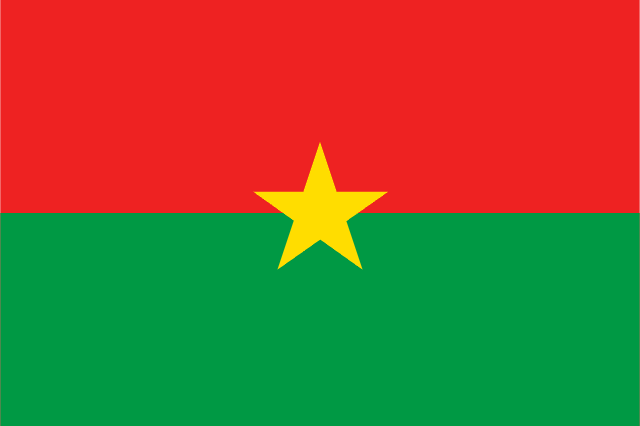
The flag of Burkina Faso features two horizontal bands of red on top and green on the bottom, with a central yellow five-pointed star. Red represents the socialist revolution and the blood shed during the national struggle; green symbolizes the natural wealth, agriculture, and forests of the country. The yellow star represents the guiding light of the revolution and progress. The flag was adopted on August 4, 1984, by revolutionary leader Thomas Sankara to replace the flag of Upper Volta, reflecting a break with the colonial past.
3. Path to Freedom & Sovereignty
The colony of French Upper Volta gained independence from France on August 5, 1960, under President Maurice Yameogo. The post-colonial era was characterized by military coups and economic stagnation. In 1983, a revolutionary government led by Captain Thomas Sankara took power. Sankara launched major social and economic reforms, promoted self-reliance, and changed the country's name from Upper Volta to Burkina Faso (meaning 'Land of Incorruptible People') in 1984, before he was assassinated in a coup in 1987.
Key Historical Milestones
French forces capture Ouagadougou, establishing a colonial protectorate over the Mossi kingdoms.
France establishes the colony of French Upper Volta, delineating its administrative borders.
Upper Volta gains independence from France on August 5 under President Maurice Yameogo.
Thomas Sankara renames the country Burkina Faso and adopts the red-green flag with the yellow star.
Two successive military coups occur in January and September, driven by security crises.
4. Modern Geopolitical Challenges
Burkina Faso faces severe security and humanitarian crises. The country has been severely affected by Islamist militant insurgencies spilling over from neighboring Mali since 2015, resulting in thousands of civilian casualties and displacing over 2 million people. This security crisis has led to severe political instability, including two military coups in 2022. Additionally, Burkina Faso struggles with high poverty rates, water scarcity, and desertification due to climate change.
Frequently Asked Questions
What does the name 'Burkina Faso' mean?
It translates to 'Land of the Incorruptible (or Upright) People', combining words from the local Mossi and Dyula languages.
Who was Thomas Sankara?
He was a charismatic Marxist revolutionary leader who governed from 1983 to 1987, known as 'Africa's Che Guevara' for his progressive anti-colonial policies.
Think You Can Pin Burkina Faso on the Map?
Use the landscape and flag clues you just learned to spot this country in our free Street View guessing game.
Play LostStreet Guessing Game