
1. Geographical & Map Formation
Azerbaijan is situated at the boundary of Eastern Europe and Western Asia, bordered by the Caspian Sea to the east. The country's borders were shaped by 19th-century imperial conflicts. Following the Russo-Persian Wars, the Treaty of Gulistan (1813) and the Treaty of Turkmenchay (1828) divided ethnic Azeri territories between the Russian Empire in the north and the Qajar Persian Empire in the south, leaving a substantial Azerbaijani population in northwestern Iran. In the Soviet era, its administrative borders were established as a Soviet Socialist Republic, which included the Nakhchivan exclave (separated by Armenian territory) and the Nagorno-Karabakh region, setting the stage for complex boundary wars when the nation regained independence in 1991, neighboring countries like Armenia.
2. Heraldry & Flag Symbolism
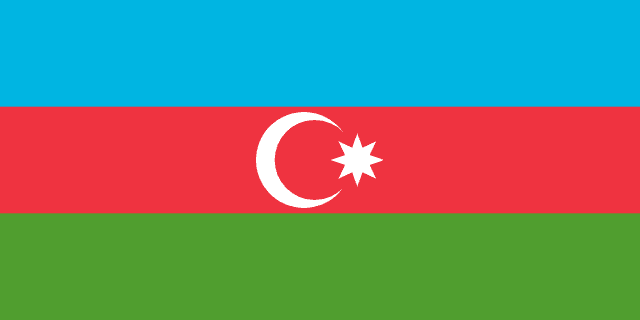
The national flag of Azerbaijan features three horizontal bands of blue, red, and green, with a white crescent and an eight-pointed star in the center red band. Blue represents the country's Turkic heritage; red symbolizes modern progress, democracy, and development; and green represents Islamic civilization. The crescent is a traditional symbol of Islam, and the eight-pointed star stands for the eight branches of the Turkic peoples. The flag was originally designed and adopted by the short-lived Azerbaijan Democratic Republic in 1918. It was banned under Soviet rule and officially restored on November 9, 1990, just before the dissolution of the USSR.
3. Path to Freedom & Sovereignty
Azerbaijan declared independence as the Azerbaijan Democratic Republic on May 28, 1918, establishing the first secular democratic republic in the Muslim world. However, in April 1920, the Bolshevik Red Army invaded Baku, and the country was incorporated into the Soviet Union. As the USSR collapsed, Azerbaijan restored its independence on October 18, 1991. The early years of independence were marked by ethnic political instability and the First Nagorno-Karabakh War, but the country gradually stabilized its sovereignty in the late 1990s under the leadership of Heydar Aliyev.
Key Historical Milestones
The Treaty of Turkmenchay divides Azerbaijani lands between the Russian and Persian Empires.
The Azerbaijan Democratic Republic declares independence as the first secular democracy in the Muslim world.
Soviet forces invade Baku, dissolving the republic and establishing Soviet Azerbaijan.
Azerbaijan restores its independence from the collapsing Soviet Union on October 18.
Azerbaijan regains control of territories in Karabakh after a 44-day war with Armenia.
4. Modern Geopolitical Challenges
Azerbaijan faces challenges related to its political governance and economic structure. The country has an authoritarian system with limited political dissent and human rights concerns. Economically, Azerbaijan is heavily dependent on oil and gas exports from its Caspian Sea fields, making the national budget vulnerable to global energy market fluctuations. The country also navigates complex border tensions and military expenditures following conflicts with neighboring Armenia, alongside the task of rebuilding infrastructure in recently recaptured territories.
Frequently Asked Questions
What does the eight-pointed star on the Azerbaijan flag represent?
The eight-pointed star represents the eight branches of the Turkic peoples, highlighting Azerbaijan's cultural heritage.
What was the significance of the 1918 Azerbaijan Republic?
It was the first secular democratic republic established in the Muslim world, granting women voting rights before many Western nations.
Think You Can Pin Azerbaijan on the Map?
Use the landscape and flag clues you just learned to spot this country in our free Street View guessing game.
Play LostStreet Guessing Game