
1. Geographical & Map Formation
Cambodia is located in the southern part of the Indochinese Peninsula, bordering Thailand, Laos, Vietnam, and the Gulf of Thailand. Evolving from the powerful Khmer Empire, which dominated mainland Southeast Asia between the 9th and 15th centuries, the country's borders were severely reduced by neighboring empires during its decline. In 1863, to prevent total annexation, King Norodom signed a treaty establishing a French protectorate. French authorities drew boundaries that stabilized the border with Thailand and Vietnam, frequently using mountain watersheds and river channels (like the Mekong) to define the territory of modern Cambodia, not far from maritime neighbors like Brunei.
2. Heraldry & Flag Symbolism
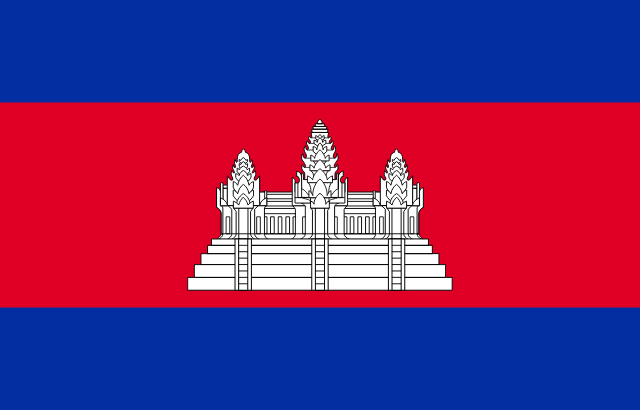
The national flag of Cambodia consists of two blue horizontal bands on the top and bottom and a red middle band, charged in the center with a white depiction of the temple of Angkor Wat. Blue represents royalty and the country's King; red symbolizes the nation, bravery, and the blood of the people; and the white Angkor Wat temple represents national heritage, spiritual faith, and the historical greatness of the Khmer Empire, originally designed in 1948 and restored in 1993.
3. Path to Freedom & Sovereignty
Cambodia achieved independence from France peacefully on November 9, 1953, under the leadership of King Norodom Sihanouk, who used diplomatic campaigns to secure sovereignty. The country remained neutral during the early years of the Cold War but was subsequently dragged into the Vietnam War. In 1975, the radical communist Khmer Rouge regime took power, launching a genocidal reign that resulted in the deaths of an estimated 1.7 to 2 million Cambodians, before being overthrown by Vietnamese forces in 1979.
Key Historical Milestones
Jayavarman II declares himself universal monarch, founding the Khmer Empire.
Cambodia becomes a French protectorate to secure defense against Siam and Vietnam.
Cambodia achieves full independence from France on November 9, led by King Norodom Sihanouk.
The Khmer Rouge regime rules Cambodia, executing millions in the Killing Fields.
UN-sponsored elections are held, restoring the monarchy and the original national flag.
4. Modern Geopolitical Challenges
Cambodia struggles with the long-term legacy of the Khmer Rouge genocide, which decimated its educated population and institutional structures. Contemporary challenges include widespread corruption, weak democratic institutions under the long-standing rule of the ruling party, and high youth unemployment. Economically, Cambodia is heavily dependent on garment manufacturing and tourism, making it vulnerable to global demand shifts, alongside the need to improve rural healthcare and education.
Frequently Asked Questions
What is the significance of Angkor Wat on the flag?
Angkor Wat represents national heritage, spiritual faith, and the historic achievements of the 12th-century Khmer Empire.
Who led the Khmer Rouge regime?
Pol Pot led the Khmer Rouge regime, which ruled Cambodia from 1975 to 1979 and caused the deaths of nearly a quarter of the population.
Think You Can Pin Cambodia on the Map?
Use the landscape and flag clues you just learned to spot this country in our free Street View guessing game.
Play LostStreet Guessing Game