
1. Geographical & Map Formation
Algeria is the largest country in Africa, situated on the Mediterranean coast with a vast Saharan desert hinterland. Its northern boundaries and southern desert frontiers are largely a product of French colonial administration between 1830 and 1962. Before the French invasion, the region was governed by the Ottoman Regency of Algiers in the north, while the vast desert was controlled by various nomadic Tuareg confederations and Saharan trading towns. French colonial authorities merged these distinct territories into a single centralized colony, pushing borders deep into the Sahara to control rich oil and natural gas fields discovered in the mid-20th century. Upon independence in 1962, the new government successfully asserted sovereignty over these colonial borders under the international principle of uti possidetis juris, securing a vast territory that is 80% desert, bordering West African states like Benin.
2. Heraldry & Flag Symbolism
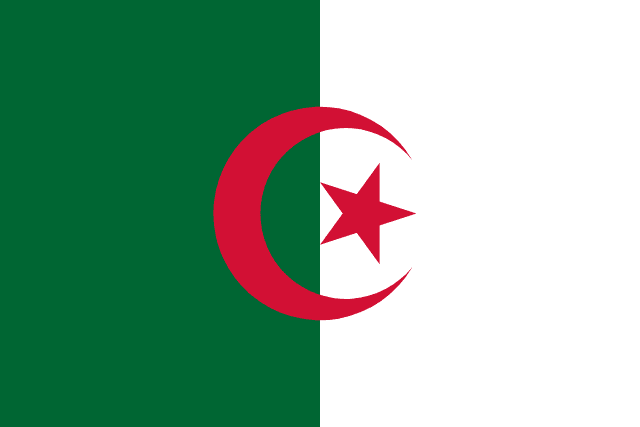
The flag of Algeria consists of two equal vertical bands of green and white, charged in the center with a red star and crescent. The green band represents Islam, the natural beauty of the land, and agricultural hope; the white band symbolizes peace, purity, and the return to sovereignty. The red crescent and star are traditional symbols of Islam and Ottoman heritage, with red representing the blood of the millions of martyrs who died fighting for freedom. The modern design is attributed to Messali Hadj, a nationalist leader who created the flag in 1928 for the 'Etoile Nord-Africaine' liberation movement, and it was officially adopted by the Provisional Government of the Algerian Republic (GPRA) in 1958 before becoming the national flag upon independence in 1962.
3. Path to Freedom & Sovereignty
Algeria's colonization by France was exceptionally brutal, involving systemic land confiscation, cultural suppression, and the imposition of French department status, meaning it was officially part of France. After decades of peaceful protests failed to yield equal rights, the National Liberation Front (FLN) launched the Algerian War of Independence on November 1, 1954. The war lasted eight years and was characterized by guerrilla warfare, urban terrorism, and extreme violence on both sides. The conflict cost the lives of an estimated 1.5 million Algerians. Under international pressure and domestic strain, French President Charles de Gaulle negotiated the Evian Accords in March 1962. Following a national self-determination referendum where 99% of voters chose independence, Algeria declared its sovereignty on July 5, 1962.
Key Historical Milestones
France invades Algiers, beginning a brutal 132-year period of colonial rule.
The National Liberation Front (FLN) launches coordinated attacks, starting the Algerian War of Independence.
The Evian Accords are signed, and Algeria officially declares independence on July 5.
A civil war erupts following canceled legislative elections, leading to a decade of violence.
The Hirak mass protest movement leads to the resignation of long-term President Abdelaziz Bouteflika.
4. Modern Geopolitical Challenges
Algeria's contemporary challenges are primarily economic and environmental. The state suffers from a high dependency on oil and natural gas exports, which account for over 90% of its export revenues, leaving the national budget vulnerable to volatile global energy markets. This resource concentration has hindered the diversification of the economy, resulting in high unemployment rates, particularly among the youth. Environmentally, Algeria is on the frontlines of climate change; desertification is actively creeping northward, threatening the fertile coastal agricultural strip, while severe water scarcity and rising temperatures present significant hurdles for future urban planning and food security.
Frequently Asked Questions
What was the human cost of the Algerian War of Independence?
The war cost the lives of an estimated 1.5 million Algerians, earning the nation the moniker 'The Land of a Million Martyrs'.
What is the meaning of the white color on the Algerian flag?
The white color symbolizes peace, purity, and the reclamation of national sovereignty after 132 years of French colonization.
Think You Can Pin Algeria on the Map?
Use the landscape and flag clues you just learned to spot this country in our free Street View guessing game.
Play LostStreet Guessing Game